

Gum Turpentine Oil Market Size to Reach USD 29.50 Million by 2033, Growing at 6.0% CAGR on Rising Renewable Solvent Demand in Coatings and Adhesives – Verified Market Research
The Gum Turpentine Oil Market is set for steady expansion through 2033 as coatings, adhesives, and cleaning product manufacturers increasingly turn to terpene-based, renewable solvent inputs to meet formulation and compliance requirements. According to Verified Market Research®, demand is being reinforced by industrial processing optimization, tightening documentation and traceability standards, and the gradual modernization of end-use formulations across construction, automotive, healthcare, chemicals, and consumer goods sectors. While compliance costs, feedstock price volatility, and specification inconsistency remain structural restraints, the Gum Turpentine Oil Industry is expected to see qualification-led, application-specific growth rather than abrupt demand shocks.
Lewes, Delaware, Sept. 09, 2026 (GLOBE NEWSWIRE) -- Gum Turpentine Oil Market Size & Forecast
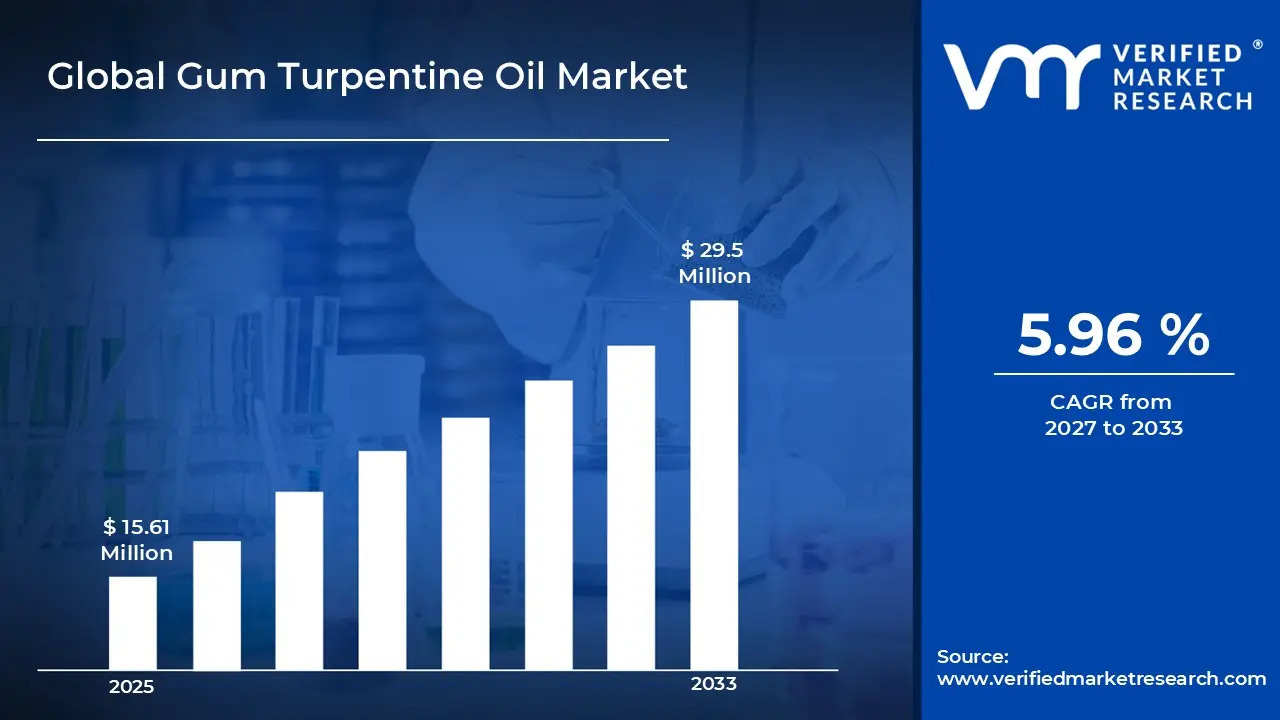
The Gum Turpentine Oil Market Size was valued at USD 15.61 Million in 2025 and is projected to reach USD 29.50 Million by 2033, registering a Compound Annual Growth Rate (CAGR) of 6.0% over the 2025–2033 forecast period, according to a new report published by Verified Market Research®. Separately, the report also characterizes the Gum Turpentine Oil Market as estimated to grow at a CAGR of 5.96%, reaching approximately USD 29.5 Million by the end of 2033, reinforcing the market's steady, incremental growth trajectory rather than a sudden step-change in demand. For industry stakeholders, this implied Gum Turpentine Oil Market growth rate signals that capacity planning, commercial contract structures, and procurement strategies should be built for sustained year-over-year scaling rather than one-off demand cycles.
Download a free sample to access exclusive Insights, Data Charts, And Forecasts From Gum Turpentine Oil Market Sample Report
The Global Gum Turpentine Oil Market's expansion pathway, as outlined by Verified Market Research®, reflects both steady demand from downstream chemistry applications and a gradual shift toward more specialized terpene-based inputs as industrial formulations evolve. Pricing discipline, supply-side reliability, and end-use modernization are expected to shape the Gum Turpentine Oil Market's growth path more meaningfully than abrupt demand shocks, with continued utilization in coatings, adhesives, and cleaning chemistries supporting stable consumption patterns across industrial manufacturing ecosystems worldwide.
Gum Turpentine Oil Market Overview: Definition & Scope
The Gum Turpentine Oil Market covers the production, trade, and consumption of turpentine oil streams derived from pine resins, with market participation defined by the presence of physically delivered oil used as an input in downstream formulations or processing. In practical terms, the Gum Turpentine Oil Industry centers on gum-derived turpentine oil products and their type-specific supply characteristics, including how the underlying origin of the raw resin feedstock shapes purity, composition, and suitability for particular end uses. The primary function served by the market is supplying a resin-derived organic solvent and chemical feed ingredient that enables performance in surface treatments, formulation systems, and specialty industrial applications.
Participation in the market is restricted to activities tied to gum turpentine oil itself and its defined type variants, including resin-to-oil recovery pathways that result in wood turpentine, sulfate turpentine, and gum turpentine streams. The scope also encompasses market-facing products sold as these turpentine oil categories for formulation or industrial processing, rather than intermediate resin handling services that do not result in the saleable turpentine oil substance.
To remove ambiguity, the Gum Turpentine Oil Market boundary is set around resin-derived turpentine oil categories. Several adjacent products are explicitly excluded from the market scope:
- Rosin and rosin derivatives - excluded even though they are co-products in pine resin processing, because they are sold and specified as tackifiers and resin solids rather than as the turpentine oil solvent/processing stream defined in this market.
- Wood-pulp derived tall oil - excluded because its origin and chemical profile are linked to different industrial processing routes and it is typically traded under different functional specifications for fuel, fatty acid/ester recovery, and related chemical uses.
-
Synthetic solvents or petroleum-based solvent substitutes - excluded because the market scope is constrained to turpentine oil categories defined by resin-derived production logic rather than broader solvent supply markets.
Why the Gum Turpentine Oil Market matters: the market structure remains shaped by a combination of raw material dependence, multi-step chemical conversion, and regulatory oversight, creating barriers that limit purely low-cost competition. Supply is closely tied to gum sourcing and processing yields, introducing regional differences in availability and cost, while conversion and formulation integration across applications favors established processors and buyers with technical capability keeping switching behavior gradual and supporting forecast stability in the Gum Turpentine Oil Market Outlook.
Download a free sample to access exclusive Insights, Data Charts, And Forecasts From Gum Turpentine Oil Market Sample Report
Gum Turpentine Oil Market Growth Drivers
The expansion of the Gum Turpentine Oil Market is primarily driven by the link between gum turpentine chemistry and real-world formulation needs in paints, coatings, and industrial solvent systems. As manufacturers aim to maintain film formation, viscosity control, and cleaning effectiveness, terpene-derived ingredients remain relevant because they can be integrated into recipes to meet performance targets. While regulatory pressure is evolving across regions, the industry continues to adapt by shifting toward blends and processing approaches that support compliance requirements for volatile organic compound management and workplace handling, consistent with the broader direction of chemical regulation and industrial safety expectations reflected in frameworks from bodies such as the US EPA that influence downstream solvent usage and labeling considerations.
1. Formulation Shifts Toward Renewable Solvents
As formulators replace higher-constraint solvent systems with renewable and bio-based inputs, gum turpentine becomes a practical feedstock for resin and binder compatibility. This Gum Turpentine Oil Market driver intensifies because procurement teams increasingly treat solvent sourcing as a sustainability and risk-management variable, not just a cost line item. The result is a clearer pathway from policy pressure and buyer preferences to higher steady-state demand for gum turpentine oil volumes across paint, adhesive, and specialty chemical formulations.
2. Compliance and Documentation Standardization
Stronger scrutiny around handling, labeling, and quality documentation pushes producers and converters toward standardized intermediate specifications for terpene streams. When quality assurance improves through tighter grades, traceability, and process controls, buyers can qualify gum turpentine inputs faster and reduce rework. This mechanism drives Gum Turpentine Oil Market expansion by lowering the friction between suppliers and downstream plants, and over time this standardization also supports broader adoption across market applications where consistent performance is required.
3. Industrial Processing Optimization
Operational improvements in extraction, fractionation, and quality sorting can increase usable yield and stabilize output schedules for downstream converters. As producers improve reliability, buyers can plan production runs with fewer substitutions, supporting longer purchasing cycles. This driver emerges as capacity utilization goals and cost pressures align, making efficiency investments economically rational. The direct impact on the Gum Turpentine Oil Market is more predictable availability for formulation and industrial users, enabling sustained demand growth through fewer supply interruptions.
Ecosystem-Level Drivers
Across the gum turpentine ecosystem, growth is enabled by supply chain evolution that improves grade consistency and strengthens distribution reliability. Capacity expansion and consolidation among terpene processing and trading networks help move material from extraction points to industrial blending centers with fewer quality mismatches. Standardization efforts within procurement specifications and documentation reduce qualification time for downstream buyers together amplifying the core Gum Turpentine Oil Market drivers by making renewable-solvent shifts easier to execute, compliance requirements more manageable, and operational optimization more scalable across regions.
Segment-Linked Drivers Across Type
- Wood Turpentine - pulled by substitution logic in solvent and intermediate blends, where consistency and downstream compatibility determine qualification speed; adoption follows a qualification-first pattern tied to the pace of blend-recipe standardization.
- Sulfate Turpentine - demand responds strongly to operational and yield improvements, since segment economics are tightly linked to processing throughput and unit reliability, making growth more sensitive to supply-side performance than end-use formulation cycles.
-
Gum Turpentine - most directly influenced by compliance and documentation standardization, given its use in quality-sensitive formulations that require predictable specification control, supporting a steadier expansion profile as qualification approvals convert into repeat purchases.
Gum Turpentine Oil Market Emerging Opportunities
Verified Market Research® identifies three principal opportunity areas for participants in the Gum Turpentine Oil Market, each tied directly to specification-driven formulation upgrades, technical repositioning, and regional grade differentiation.
Low-VOC, Solvent-Balanced Coatings
Formulators are increasingly constrained by performance targets and odor or emission expectations, creating room for gum turpentine oil where solvent functionality must be preserved while reducing perceived end-user friction. The opportunity emerges as coating recipes are being re-validated and resourced across procurement cycles, addressing specification mismatch and channel under-education and enabling suppliers to win longer qualification windows and improved share in Paints & Coatings.
Adhesives and Sealants Requiring Tack, Plasticization, and Compatibility
Adhesives and sealants are facing more complex substrate combinations, including surfaces that demand stable wetting and controlled viscosity. Gum turpentine oil can act as a functionality lever, but adoption has lagged where procurement teams lack clear guidance on compatibility and handling. The timing is favorable as new product launches run qualification tests, and addressing documentation gaps and supply consistency can convert latent need into repeat purchasing and multi-SKU penetration.
Regional Cleaning Products Grade Differentiation
Cleaning products increasingly balance efficacy with practical constraints on storage, dosing, and customer tolerance for odor and residues. Gum turpentine oil can support solvency and cleaning power, yet product-grade differentiation and stable delivery have not always matched local formulation and distributor expectations. This opportunity is emerging as product refresh cycles and inventory planning tighten, with targeted grade bundling and reliability commitments able to unlock distributor-led expansion into underserved geographies.
Beyond these three clusters, Verified Market Research® notes that the Gum Turpentine Oil Market is positioned for faster adoption when upstream supply coordination and downstream technical alignment move together including supply chain optimization, specification standardization, regulatory alignment on handling and exposure documentation, and investment in blending, logistics readiness, and quality assurance infrastructure that support new entrants and faster partnerships with coating, adhesives, and cleaning formulators.
Download a free sample to access exclusive Insights, Data Charts, And Forecasts From Gum Turpentine Oil Market Sample Report
Gum Turpentine Oil Market Challenges & Restraints
Stringent Safety, Labeling, and Solvent Handling Rules
Gum turpentine oil is commonly treated as a volatile organic solvent, which triggers workplace exposure controls, storage and transport labeling, and site-level permitting requirements. These obligations increase operating overhead for paints and coatings, adhesives and sealants, and cleaning products manufacturers, while also lengthening vendor qualification cycles. As a result, buyers either reduce solvent content, switch to lower-compliance inputs, or delay adoption until internal EHS governance approvals are completed.
Price Volatility and Upstream Collection Uncertainty
The gum turpentine oil supply chain depends on raw material availability and consistent extraction yields, which can fluctuate with sourcing conditions and logistics disruptions. When feedstock economics become unstable, contracts and procurement planning face tighter risk controls, especially in chemicals-intensive applications such as rubber processing and printing inks. This dynamic forces buyers to hedge or postpone capacity expansion, directly limiting the number of active trials and reducing long-term purchasing commitments at the category level.
Inconsistent Product Specifications
Performance of gum turpentine oil in formulated systems depends on compositional consistency, impurities, and batch-to-batch behavior. Variability complicates qualification for high-sensitivity formulations across pharmaceuticals and fragrances, where tolerances for odor, purity, and reactivity can be narrow. Even when functional interchange is technically possible, manufacturers often require repeated verification testing, formulation rework, and stability studies, which increases lead times and discourages broader rollout.
At the ecosystem level, these restraints are amplified by supply chain bottlenecks, fragmented sourcing practices, and limited standardization across batches. Extraction capacity and regional access create uneven availability, while inconsistent specification management increases the time required for downstream customers to complete qualification raising effective delivered cost through rerouting and compliance documentation, and increasing testing uncertainty that slows scaling in solvent-dependent formulations.
Gum Turpentine Oil Market Technology & Innovation Trends
Technology is shaping the Gum Turpentine Oil Market by changing how turpentine fractions are produced, refined, and validated for end-use requirements. The evolution is largely incremental in core chemistry and separation, but increasingly transformative in how supply chains manage variability, quality consistency, and compliance across applications. From paints and coatings to adhesives, fragrances, and rubber processing, technical capability determines adoption because formulation teams need predictable material behavior and stable impurity profiles.
Process Stabilization to Reduce Lot Variability
Stabilization-oriented process controls tighten the relationship between raw material characteristics and final product quality by improving consistency across batches. This addresses formulation sensitivity to odor, clarity, and impurity levels that can otherwise lead to reformulation, extended testing cycles, or rejected lots supporting better performance predictability in paints and coatings, adhesives and sealants, and fragrance-related applications while enabling smoother scaling from smaller to larger production runs.
Improved Purification Pathways for Application-Specific Compliance
Purification capability is evolving toward more application-specific outcomes, particularly for segments with stricter specification expectations. Enhanced removal of components that contribute to undesired odor, color, or reactivity supports consistent behavior in printing inks, cleaning products, and specialty intermediate uses, reducing the gap between generic turpentine output and the requirements of downstream users and decreasing dependency on extensive custom blending for every customer lot.
Downstream Quality Assurance Aligned With End-Use Validation
Quality assurance is becoming more tightly integrated with end-use validation rather than relying solely on broad release specifications. Analytical and workflow improvements help producers demonstrate that turpentine streams remain stable during storage and meet practical criteria relevant to use, such as compatibility with coating systems or cleanliness for cleaning formulations supporting consistent supply to chemical processors and consumer goods manufacturers who depend on predictable batch performance.
Gum Turpentine Oil Industry Use-Cases & End-User Applications
The Gum Turpentine Oil Market manifests as an input material whose relevance depends on how processing and formulation constraints interact with end-product performance. Across applications ranging from solvent-driven coating systems to resin-based adhesives and specialty aroma profiles, demand is shaped by practical requirements such as volatility management, solvency power, compatibility with binders, and trace impurity tolerances.
Solvent-and-Drying-Performance Support in Coating and Ink Production
In industrial coating plants and ink manufacturing environments, gum turpentine oils are used within formulation and process steps where liquid handling affects end-product defects. Producers blend turpentine fractions to tune viscosity for application methods such as brushing, rolling, or printing, and to influence drying and film formation behavior after deposition on substrates, driving demand through procurement routines tied to formulation changes, seasonal solvent-blend adjustments, and quality requirements that reduce rejects.
Compatibility-Driven Processing Aid in Rubber and Polymer Workflows
In rubber processing lines, turpentine oil use centers on maintaining stable process conditions while supporting polymer handling. Manufacturers incorporate turpentine-type solvents or processing components to help manage compound workability during mixing and support downstream processing steps that determine uniformity and surface quality, with demand influenced by maintenance of yield and reduced variability in batch performance.
Fragrance and Specialty Formulation Inputs
In fragrance and select specialty formulation settings, gum turpentine oils are handled as functional inputs where sensory outcomes and documentation readiness are operational priorities. Formulators incorporate turpentine-derived components to contribute to scent structure and support stability requirements across product life, with demand sensitive to formulation revisions, new product launches, and shifts in customer specifications.
By end-user industry, Construction is expected to support durable consumption through steady demand for coatings, sealants, and related materials tied to renovation and infrastructure cycles. Automotive contributes through recurring demand for components and finishing chemistries, though it can be more cyclical with production swings. Healthcare and Consumer Goods typically add stability because formulation and cleaning requirements persist through longer procurement horizons, even as purchasing volumes may fluctuate by product lifecycle. Chemicals, as an upstream consolidator of industrial inputs, can amplify growth when secondary processing expands, but it also introduces tighter linkage to broader industrial activity.
Download a free sample to access exclusive Insights, Data Charts, And Forecasts From Gum Turpentine Oil Market Sample Report
Gum Turpentine Oil Market Regulatory & Policy Landscape
The Gum Turpentine Oil Market operates in a moderately to highly regulated environment where environmental, occupational safety, and chemical quality expectations influence operating models. Compliance requirements shape market entry by increasing documentation, testing, and process-control needs, which can delay time-to-market and raise effective capital and labor costs. Policy can act as both a barrier and an enabler: environmental enforcement can constrain supply and tighten acceptable feedstock and emissions practices, while industrial chemicals and coatings policy frameworks can support demand growth through standards harmonization and procurement rules. Verified Market Research® characterizes regulation as a structural factor affecting pricing stability, supplier consolidation, and long-term growth potential through the 2025 - 2033 horizon.
Market entry typically requires verifiable quality management, including batch-level testing or validation to demonstrate consistency for sensitive applications such as paints, adhesives, pharmaceuticals-adjacent inputs, and fragrances. Certifications and documentation frameworks also influence buyer qualification cycles, particularly with customers that require supplier audit trails, traceability, and handling protocols raising entry barriers through higher upfront compliance spend and longer approval timelines, while improving competitive positioning for firms that can sustain consistent output and documentation quality at scale.
Gum Turpentine Oil Market Trends
The Gum Turpentine Oil Market is evolving toward a more application-specific and process-aligned value chain, with demand behavior shifting from broad, commodity-style purchasing to tighter specifications by end use. Over the 2025 - 2033 forecast period, the technology footprint becomes more targeted, emphasizing consistent composition handling across downstream formulations rather than generic blending practices.
- Formulation traceability as a purchasing criterion - procurement behavior is shifting toward lot-level traceability and documented handling parameters, especially for applications where sensory profile, solvent behavior, or impurity sensitivity affects final performance.
- Type-specific product handling - gum turpentine is increasingly treated as a functional input tied to specific end-use performance bands across Paints & Coatings, Adhesives & Sealants, and Fragrances.
- Standardization of downstream processing - buyers increasingly design workflows around predictable evaporation, mixing compatibility, and application-specific usability, particularly in Rubber Processing and Printing Inks.
- Multi-application supplier consolidation - buyers increasingly favor suppliers capable of supporting diverse downstream needs with consistent documentation, particularly across Chemicals and Consumer Goods end-user industries.
- Tightening distribution and lot traceability - buyers are aligning inbound logistics with internal risk management and formulation governance, especially where turpentine inputs interact with sensitive Healthcare-related cleaning applications.
- Cross-application reassessment - downstream teams increasingly reassess gum turpentine compatibility across related categories such as Cleaning Products, Paints & Coatings, and Adhesives & Sealants, broadening its practical scope of use.
Download a free sample to access exclusive Insights, Data Charts, And Forecasts From Gum Turpentine Oil Market Sample Report
Gum Turpentine Oil Market Regional Outlook
The Gum Turpentine Oil Market varies meaningfully across North America, Europe, Asia Pacific, Latin America, and the Middle East & Africa as regional demand maturity, regulatory posture, and industrial structure diverge. North America and Europe tend to show more mature consumption patterns, driven by established downstream manufacturing in paints & coatings, adhesives & sealants, and specialty chemical inputs, alongside stricter compliance expectations around hazardous constituents and emissions handling. Asia Pacific generally behaves as the faster-adopting region, where industrial output growth and expanding manufacturing capacity increase baseline demand. Latin America and the Middle East & Africa often display more cyclical behavior tied to construction activity, consumer goods production, and the pace of investment in chemical processing capacity.
North America Gum Turpentine Oil Market
In North America, the market structure reflects a mature but innovation-sensitive industrial base. Demand is closely tied to upstream availability and the steady needs of downstream segments such as paints & coatings, printing inks, cleaning products, and rubber processing. Procurement behavior is shaped by operational compliance expectations, including workplace safety and facility-level controls for flammable organics and volatile byproducts.
- End-user concentration - dense manufacturing clusters support steadier offtake in paints & coatings, adhesives & sealants, and printing inks.
- Process safety and emissions enforcement - influences storage, transportation choices, and operational viability of certain grades within end-user processes.
- Formulation innovation over broad substitution - operators pursue performance-driven reformulation rather than wholesale replacement of turpentine-based inputs.
- Capital investment in processing upgrades - modernized handling and solvent recovery systems stabilize demand for feedstock inputs.
- Supply chain and qualification maturity - established logistics and supplier qualification routines lower switching costs once technical criteria are met.
- Multi-year enterprise qualification cycles - demand changes typically move through validated supply agreements and trial-to-scale pathways, moderating volatility.
Europe Gum Turpentine Oil Market
Europe's position in the market is shaped less by raw supply availability and more by regulatory discipline, product stewardship, and strict process controls governing terpene-related inputs. EU-level harmonization affects how gum turpentine oil grades are qualified for paint, adhesives, and specialty applications, pushing producers toward consistent specifications and traceable sourcing.
- EU harmonization and specification tightness - buyers increasingly require consistent terpene composition, impurity thresholds, and labeling alignment.
- Sustainability compliance pressure - environmental and health expectations influence how turpentine oil blends are assessed in coatings, cleaning products, and related chemistries.
- Cross-border industrial integration - multi-country procurement requires standardized technical documentation and reliable logistics.
- Quality and certification as commercial gatekeepers - qualification for pharmaceuticals-adjacent and regulated chemical uses hinges on safety documentation and supplier accountability.
- Regulated innovation cycles - structured development and validation lengthen lead times from prototype to adoption for gum turpentine oil-derived inputs.
- Institutional procurement influence - public and institutional procurement frameworks shape product standards in construction-related coatings and industrial maintenance inputs.
Asia Pacific Gum Turpentine Oil Market
Asia Pacific plays a high-growth role in the Gum Turpentine Oil Market, driven by expansion in downstream manufacturing and fast-changing end-use demand profiles. Market behavior differs across Japan and Australia, where chemical and specialty production is more process-intensive, versus India and parts of Southeast Asia, where capacity additions and scale-up cycles are faster and often tied to broader industrialization.
- Uneven manufacturing base expansion - industrialization is concentrated in specific corridors and industrial parks, creating localized demand spikes.
- Population and urban construction scale effects - large population centers sustain baseline consumption for construction-related coatings and household cleaning formulations.
- Cost competitiveness - sourcing, blending, and labor cost structures vary by country depending on logistics and processing infrastructure maturity.
- Infrastructure development - port capacity, inland transport, and warehouse expansion shorten lead times for resin systems and specialty formulations.
- Regulatory divergence - chemical handling, worker safety, and labeling expectations vary substantially across the region.
- Government-led industrial initiatives - policies and investments in chemical parks and export-oriented supply chains shift where new capacity emerges.
Latin America Gum Turpentine Oil Market
Latin America represents an emerging segment within the Gum Turpentine Oil Market, expanding gradually as industrial use cases broaden beyond traditional solvent applications. Demand in key economies such as Brazil, Mexico, and Argentina is typically linked to construction activity, packaging and printing requirements, and locally produced formulations in paints, adhesives, and cleaning products.
- Currency-driven demand instability - volatility in local currencies alters the effective cost of turpentine inputs and can smooth volume growth into smaller, less predictable ordering patterns.
- Uneven industrial base - the regional industrial footprint varies widely between Brazil, Mexico, and other markets.
- Import dependence - constrained domestic sourcing or processing capacity makes supply continuity sensitive to cross-border logistics and lead times.
- Logistics and infrastructure constraints - transport reliability and storage infrastructure can raise effective distribution costs, shifting purchasing toward regional suppliers or smaller pack formats.
- Regulatory variability - differences in chemical handling standards and labeling requirements create uneven compliance costs across national markets.
- Gradual foreign investment - cross-border capital inflows and supplier partnerships tend to expand capacity incrementally rather than abruptly.
Middle East & Africa Gum Turpentine Oil Market
Verified Market Research® frames the Gum Turpentine Oil Market in the Middle East & Africa as selectively developing rather than uniformly expanding across geographies. Gulf economies set the pace through construction-linked activity, advanced manufacturing initiatives, and periodic localization drives, while demand formation in South Africa and parts of North and East Africa is more dependent on import flows and the pace of industrial upgrading.
- Policy-led industrial diversification in Gulf economies - procurement and industrial strategy prioritize downstream capability building, raising consumption of turpentine inputs into paints, adhesives, and related formulations.
- Infrastructure and industrial readiness gaps - warehousing, solvent supply reliability, and chemical handling standards are not uniformly established across African markets.
- High dependence on imported supply - much of the value chain depends on import availability for turpentine fractions and blend components.
- Concentrated demand in urban and institutional centers - demand clusters where construction cycles, healthcare procurement, and institutional chemical usage are densest.
- Regulatory inconsistency - differing handling, labeling, and operational requirements influence adoption rates for sensitive end uses such as pharmaceuticals and fragrances.
-
Gradual market formation through public-sector projects - public-sector infrastructure programs and strategic industrial zones can accelerate demand, though effects are unevenly distributed.
Download a free sample to access exclusive Insights, Data Charts, And Forecasts From Gum Turpentine Oil Market Sample Report
Gum Turpentine Oil Market Competitive Landscape
The competitive structure of the Gum Turpentine Oil Market remains moderately fragmented, with participation spanning global chemical firms, specialty terpene processors, and regionally rooted resin and turpentine suppliers. Competition centers on three practical levers product performance consistency for downstream formulations such as paints, inks, and adhesives compliance and documentation quality for health and environmental controls across end-use applications and supply reliability shaped by feedstock availability and extraction capacity. In the context of the Gum Turpentine Oil Market Forecast from 2025 to 2033, competitive intensity is expected to shift from simple volume competition toward qualification-led procurement, where technical traceability and application fit increasingly determine switching behavior.
Kraton Corporation
Kraton Corporation's role in the Gum Turpentine Oil Market is best understood as an integrator of terpene-derived inputs into higher-value material systems, aligning with downstream requirements where turpentine components must behave predictably in resin and polymer-adjacent formulations. Its differentiating influence comes from translating raw terpene characteristics into formulation specifications used by industrial customers, which reduces variability risk during scale-up and strengthens qualification barriers for suppliers unable to demonstrate consistent quality parameters.
Eastman Chemical Company
Eastman Chemical Company's role is oriented toward scale, process discipline, and systems-level material engineering, which can indirectly strengthen demand for gum turpentine oil as part of broader chemical feedstock strategies. Its competitive positioning rests on establishing procurement certainty and process integration for industrial customers managing formulation risk tightly, rather than competing purely on lowest-cost supply.
Symrise AG
Symrise AG functions as an application-facing supplier where terpene inputs connect to fragrance and related specialty formulations. Within the Gum Turpentine Oil Market, this creates a distinctive competitive pathway that rewards sensory consistency, odor profile repeatability, and formulation compatibility for personal care, home care, and fragrance applications.
Hindustan Resins & Terpenes
Hindustan Resins & Terpenes represents a regional-scale specialist angle, with influence linked to feedstock utilization, regional distribution, and practical qualification support for downstream customers in chemicals and consumer-adjacent industries. Its competitive behavior emphasizes throughput capability and localized availability that reduce logistics friction for manufacturers.
Beyond these profiled companies, the Gum Turpentine Oil Market also includes participation from International Flavors & Fragrances Inc., Harima Chemicals Group, Inc., Wuzhou Pine Chemicals Ltd., Foreverest Resources Ltd., and Mentha & Allied Products Pvt. Ltd. These additional players cluster into three competitive roles: fragrance and flavor ecosystem participants with specialty formulation influence, terpene and resin supply specialists with quality and extraction focus, and emerging regional entrants that expand geographic coverage and contracting capacity. Collectively, they keep competition balanced across quality-led qualification, regional logistics advantages, and application-driven specification requirements.
Download a free sample to access exclusive Insights, Data Charts, And Forecasts From Gum Turpentine Oil Market Sample Report
Gum Turpentine Oil Market Segmentation
By Type
- Wood Turpentine
- Sulfate Turpentine
- Gum Turpentine
By Application
- Paints & Coatings
- Adhesives & Sealants
- Pharmaceuticals
- Fragrances
- Rubber Processing
- Printing Inks
- Cleaning Products
By End-User Industry
- Construction
- Automotive
- Healthcare
- Chemicals
- Consumer Goods
By Geography
- North America
- Europe
- Asia Pacific
- Latin America
- Middle East & Africa
Strategic Outlook Through 2033
Verified Market Research® expects the Gum Turpentine Oil Market to continue its incremental, qualification-led growth path from USD 15.61 Million in 2025 to USD 29.50 Million by 2033, reflecting a 6.0% CAGR built on application-level pull rather than one-off project orders. Growth distribution across the market is expected to remain concentrated where industrial throughput is sustained and where formulation switching is constrained by performance requirements favoring suppliers able to manage consistent quality, predictable supply, and commercial terms that can withstand upstream variability, particularly in Paints & Coatings, Adhesives & Sealants, and Cleaning Products.
Opportunity concentration is expected to remain highest where qualification and formulation tuning create switching costs. Gum-derived material is structurally positioned for application-specific grades, while other turpentine types may compete more on availability and baseline performance depending on regional supply economics. Pharmaceuticals and fragrances represent under-penetrated value pools where trust, traceability, and controlled quality can outweigh price in procurement decisions, though adoption cycles require time and documentation readiness.
Strategic prioritization in the Gum Turpentine Oil Market should balance where scale can be achieved with where qualification risk is highest. Capacity and operational optimization can deliver shorter-term value where throughput reliability and cost control are binding constraints, while application-specific product expansion and innovation in distillation and impurity management are better suited to mid-to-long-term value capture where switching costs and formulation knowledge create durable customer relationships. In practice, the most defensible path through 2033 combines supply stability, measurable quality differentiation, and region-specific go-to-customer sequencing across the Gum Turpentine Oil Industry.
Related Reports
Global Acetaldehyde Market Size By Process (Oxidation of Ethylene, Oxidation of Ethanol, Dehydrogenation of Ethanol), Derivative (Pyridine & Pyridine Bases, Pentaerythritol, Ethyl Acetate, Acetic Acid), Application (Food & Beverage, Chemicals, Paints & Coatings, Plastics & Synthetic Rubber), & Region for 2024-2031
Global Acrylic Paint Markers Market Size By Type (Water Based Markers, Oil Based Markers), By Application (Interior Home Decoration, Outdoor Wall Art), By Line Width (Upto 2 MM, 1 to 6 MM), By Geographical Scope And Forecast
Global White Spirit Market Size By Type (Low Aromatic White Spirits, Medium Aromatic White Spirits, High Aromatic White Spirits), By Application (Paints and Coatings, Cleaning Agents, Adhesives), By Packaging Type (Drums, Cans, Bulk), By Geographic Scope And Forecast
Global Pine-Derived Chemicals Market Size By Type (Gum Turpentine, Gum Rosin), By Application (Paints & Coatings, Surfactants), By Geographic Scope And Forecast
Global Green Bio-Based Solvents Market Size By Type (Bio-Alcohol, Bio-Diols), By Application (Paints And Coatings, Adhesives), By Geographic Scope And Forecast
Visualize Gum Turpentine Oil Market using Verified Market Intelligence -:
Verified Market Intelligence is our BI Enabled Platform for narrative storytelling in this market. VMI offers in-depth forecasted trends and accurate Insights on over 20,000+ emerging & niche markets, helping you make critical revenue-impacting decisions for a brilliant future.
VMI provides a holistic overview and global competitive landscape with respect to Region, Country, Segment, and Key players of your market. Present your Market Report & findings with an inbuilt presentation feature saving over 70% of your time and resources for Investor, Sales & Marketing, R&D, and Product Development pitches. VMI enables data delivery In Excel and Interactive PDF formats with over 15+ Key Market Indicators for your market.
About Us
Verified Market Research® stands at the forefront as a global leader in Research and Consulting, offering unparalleled analytical research solutions that empower organizations with the insights needed for critical business decisions. Celebrating 10+ years of service, VMR has been instrumental in providing founders and companies with precise, up-to-date research data.
With a team of 500+ Analysts and subject matter experts, VMR leverages internationally recognized research methodologies for data collection and analyses, covering over 15,000 high impact and niche markets. This robust team ensures data integrity and offers insights that are both informative and actionable, tailored to the strategic needs of businesses across various industries.
VMR's domain expertise is recognized across 14 key industries, including Semiconductor & Electronics, Healthcare & Pharmaceuticals, Energy, Technology, Automobiles, Defense, Mining, Manufacturing, Retail, and Agriculture & Food. In-depth market analysis cover over 52 countries, with advanced data collection methods and sophisticated research techniques being utilized. This approach allows for actionable insights to be furnished by seasoned analysts, equipping clients with the essential knowledge necessary for critical revenue decisions across these varied and vital industries.
Verified Market Research® is also a member of ESOMAR, an organization renowned for setting the benchmark in ethical and professional standards in market research. This affiliation highlights VMR's dedication to conducting research with integrity and reliability, ensuring that the insights offered are not only valuable but also ethically sourced and respected worldwide.
Follow Us On: LinkedIn | Twitter | Threads | Instagram | Facebook

Mr. Edwyne Fernandes
Verified Market Research®
US: +1 (650)-781-4080
US Toll Free: +1 (800)-782-1768
Email: sales@verifiedmarketresearch.com
Web: https://www.verifiedmarketresearch.com/
SOURCE – Verified Market Research®

Legal Disclaimer:
EIN Presswire provides this news content "as is" without warranty of any kind. We do not accept any responsibility or liability for the accuracy, content, images, videos, licenses, completeness, legality, or reliability of the information contained in this article. If you have any complaints or copyright issues related to this article, kindly contact the author above.
